
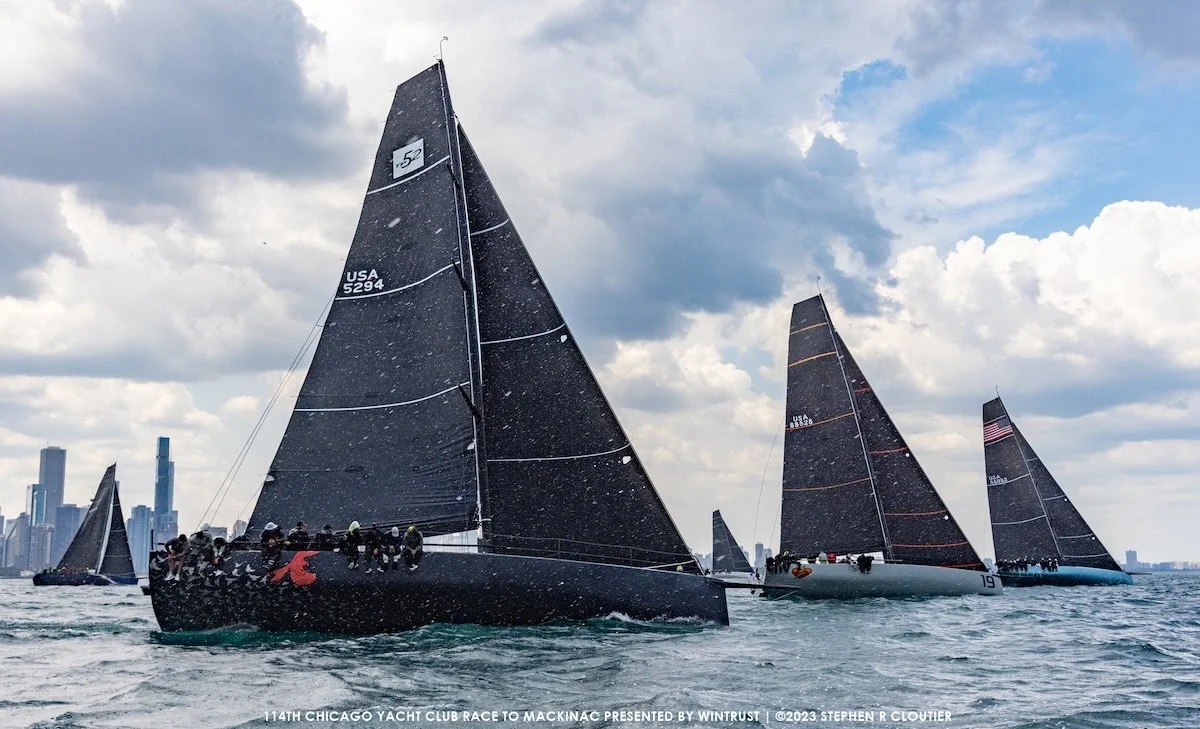
Each summer, hundreds of boats and thousands of sailors gather on Chicago’s lakefront for the Chicago Yacht Club Race to Mackinac presented by Wintrust — the largest annual offshore race in the world.
Known simply as “The Mac Race,” the race sends sailors 333 miles from Chicago to Mackinac Island, Michigan, across the full length of Lake Michigan. It is part sporting event, part endurance test, part summer tradition — and for many sailors, a bucket-list race that defines a season.
Whether you are watching from the lakefront, following the tracker from home or seeing the race for the first time, here is your guide to understanding what makes the Race to Mackinac one of the great traditions in sailing.
What is the Race to Mackinac?
The Chicago Yacht Club Race to Mackinac presented by Wintrust is a 333-mile offshore sailing race from Chicago to Mackinac Island.
As the largest annual offshore race in the world, the Mac Race brings together hundreds of boats and thousands of sailors from around the world for a race that is both intensely competitive and deeply rooted in Great Lakes tradition.
The race begins off Chicago’s Navy Pier, with boats setting out in front of the city’s skyline before heading north across Lake Michigan. From there, teams race through changing conditions, strategic decisions and overnight sailing before finishing at Mackinac Island.
The 2026 race marks the 117th running of the event.
A Chicago tradition since 1898
The Race to Mackinac was first sailed in 1898, making it one of the oldest and most storied events in American sailing.
For generations, the race has been part of Chicago’s summer sporting identity. It connects the city’s lakefront with the open waters of Lake Michigan and the historic finish at Mackinac Island, drawing sailors from across the country and around the world.
Part of what makes the Mac Race special is its combination of scale, history and unpredictability. No two races are the same. Some years bring fast downwind sailing. Others bring storms, calms, tactical splits, close finishes or long nights waiting for wind.
That variety is part of the challenge — and part of the tradition.
The course: 333 miles to Mackinac Island
The race course covers 333 statute miles from Chicago to Mackinac Island.
After the start, teams sail north through Lake Michigan, making tactical decisions about wind, weather and where to position themselves on the lake. As boats move farther up the course, they may choose different routes along the Wisconsin or Michigan sides of the lake, navigate past major landmarks such as the Sleeping Bear Dunes and the Manitou passage, and eventually work their way toward the Straits of Mackinac.
The finish comes after passing under the Mackinac Bridge and crossing the finish line between Mackinac Island and Round Island Light, one of the most recognizable destinations in the Great Lakes. For sailors, arriving at the island after racing for several nights is one of the defining moments of the Mac Race experience.
The start: when the race begins
The 2026 Race to Mackinac starts over two days.
The Cruising Division starts Friday, July 10 at 3 p.m. The Racing Division starts Saturday, July 11 beginning at 11 a.m., with class starts continuing into the afternoon.
The start is one of the best opportunities for fans to see the world’s largest annual offshore race up close. Boats gather off Chicago’s lakefront before heading north, creating one of the most memorable scenes in Great Lakes sailing.
The Skyline Sprint
In 2026, the race will again feature the Skyline Sprint, a spectator-friendly opening leg designed to bring the action closer to Chicago.
Weather permitting, boats will race north along the lakefront toward a turning mark near Montrose Beach before continuing up Lake Michigan toward Mackinac Island.
For fans, the Skyline Sprint offers a rare chance to watch the fleet race against the backdrop of the Chicago skyline. Spectators can follow the action from Navy Pier all the way up to Montrose Harbor or from the water as the boats begin their 333-mile journey north.
Who races?
The Mac Race brings together a wide range of sailors and boats.
The fleet includes family crews, first-time entries, longtime veterans, amateur sailors, experienced offshore racers and high-performance teams. Some boats are built purely for speed. Others are cruising boats taking on the race as a major adventure. Some crews have raced together for years, while others are experiencing the Mac Race for the first time.
That mix is part of what makes the race unique. The Mac Race is the largest annual offshore race in the world, but it is also deeply personal. For many teams, simply getting to the start line takes months of preparation. Finishing the race is an accomplishment. Winning it can become part of a boat’s history.
Do crews race through the night?
Yes. One of the most common questions about the Mac Race is whether sailors race overnight — and the answer is absolutely.
Even the fastest monohull in race history spent one night on the lake taking 22 hours, 24 minutes and 23 seconds to reach Mackinac Island. The current multihull record is even faster, at 18 hours, 50 minutes and 32 seconds.
But most teams spend much longer on the lake. Crews race through the day, through the night with the majority taking 2 to 3 nights to finish the race, rotating through watches as they manage weather, fatigue, navigation, boat speed and strategy.
For many sailors, those nighttime hours are among the most memorable parts of the experience.
How long does the race take?
The length of the race depends on the boat and the conditions.
Faster boats may finish in about a day when conditions line up. Most teams may spend two or more days on the water. Wind direction, wind speed, storms, calms, waves and tactical decisions can all affect how quickly teams reach Mackinac Island.
That uncertainty is part of what makes the race compelling. The race is not just a straight-line sprint. It is a long-distance challenge where preparation, patience, teamwork and decision-making all matter.
How do teams win?
In sailing, the first boat to finish is not always the overall winner.
There is an award recognizing the first boat to reach Mackinac Island, often called line honors. But many of the race’s biggest trophies are decided on corrected time. Corrected-time scoring uses boat ratings to allow different types and sizes of boats to compete more fairly against one another.
That means a smaller boat that sails an exceptional race can beat a larger, faster boat on corrected time.
The race is also divided into classes and divisions, so boats compete against others with similar characteristics. This creates competition throughout the fleet, from the fastest racing machines to family-crewed boats taking on the Mac Race together.
What makes the Mac Race so challenging?
The Race to Mackinac is more than a distance race. It is a test of preparation, navigation, endurance and teamwork.
Crews must be ready for changing Great Lakes weather, long hours on the water, overnight sailing, limited sleep and tactical decisions that can unfold over hundreds of miles. A boat may see strong breeze, light air, storms, waves, shifting winds or long stretches of patience-testing calm — sometimes all in the same race.
It is not uncommon to see severe weather while racing. In fact, some of the most notable races have had harrowing storms and conditions that have broken boats and forced teams to retire after racing through squalls and high waves.
Success requires more than speed. Teams need the right preparation, the right decisions and the ability to keep pushing together until they reach Mackinac Island.
That is why the Mac Race continues to stand apart. It is the largest annual offshore race in the world, but every team that starts becomes part of a much bigger story: one shaped by history, weather, competition, endurance and the shared pull of Mackinac Island.
How to follow the race
Fans can follow the Race to Mackinac in several ways.
Watch the start from the Chicago lakefront or from the water. Follow the race tracker as boats make their way up Lake Michigan. Watch for updates on the Race to Mackinac social channels (Instagram & Facebook) throughout race week and as the fleet finishes at Mackinac Island.
Whether you are a lifelong sailor, a Chicago sports fan or someone discovering the race for the first time, the Mac Race is one of the great summer traditions on the Great Lakes.
The 117th Chicago Yacht Club Race to Mackinac presented by Wintrust starts July 10–11.